
Building a Culture of Character Among Wake Forest Staff
Building A Culture of Character Among Wake Forest Staff
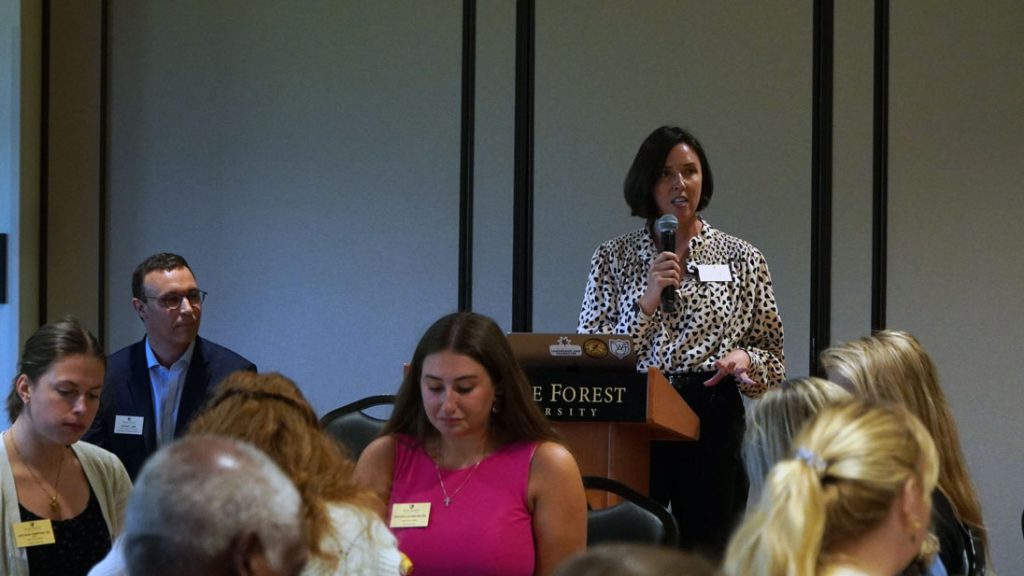
When the Leadership and Character Certificate Program launched this fall at Wake Forest, Kathleen Stimely expected 30 or 40 people to sign up. Instead, more than 170 enrolled. “Seeing that many people sign up made it clear that our community is hungry for this kind of reflective, purpose-driven learning,” says Stimely, the Senior Director of Program Administration. “It affirmed for me that employees want opportunities to think about their work through the lens of character, meaning, and community.”
Stimely is one of the Program’s founding staff members and has been at Wake Forest longer than anyone else on the team. She previously served on both the Character Project and Beacon Project teams, which introduced her to the field of virtue and moral education and shaped her conviction that character development belongs not only in research, but also in the lived culture of the university. “Because I’ve designed initiatives that support faculty and staff development, I saw a parallel opportunity to engage employees,” she says. “Those people shape the daily culture and values of the university, and I wanted them to have access to the same kind of reflective learning that had proven transformative for students.”
In addition to her experience in administration and human resources, Stimely also received a scholarship from the Kern Family Foundation and completed an MA in Character Education through the Jubilee Centre for Character and Virtues at the University of Birmingham in 2023. Her graduate research, Creating a Culture of Character in Higher Education, examined how discussion-based programs could cultivate virtues such as gratitude, purpose, and practical wisdom among university employees.
This research informed what would become the Leadership and Character Certificate Program, a professional development opportunity now open to faculty and staff across the university. The Certificate includes a series of workshops, reflection assignments, and peer dialogues that help participants cultivate virtues such as humility, courage, and practical wisdom while connecting them to the university’s mission and values.
The pilot program Stimely designed at Wake Forest invited staff to reflect on their work through the lens of character, purpose, and community. Participants described feeling more connected to colleagues, more engaged in their work, and more confident in bringing their values to the workplace. Several staff members described feeling newly empowered to reframe everyday interactions like shift check-ins, advising sessions, or residence-hall conversations as opportunities to name and practice virtues such as humility, patience, and courage. Others have shared that the certificate program helped them see their roles differently, prompting them to collaborate more intentionally, slow down and listen before responding, or create new structures that promote fairness, belonging, and ethical decision-making.
“The discussion group helped me see my work in a different light,” one participant reflected in a survey. “I felt more connected to my colleagues and more grounded in my own sense of purpose. It gave me language and space to think about the kind of community we’re trying to build here.”
“This program is designed for both faculty and staff because creating a culture of character happens not only in the classroom,” Stimely explains. “Each of us, in our different roles, shapes how character is lived out here. Staff are the culture creators of the university, and to truly build a culture of character, we have to engage the entire community. When we all investigate questions of purpose, virtue, and leadership, the institution itself becomes a place where character can truly flourish.”
Learn more about the Leadership and Character Certificate Program and join the waitlist here.
Students

- We held an initiation ceremony for our Class of 2029 Leadership and Character Scholars at the end of October. During the event, ten first-year students were recognized for their hard work and dedication to developing their character. “You are being honored not just for your impressive records…but your deep commitment to personal growth and your desire to grow in character,” said Senior Executive Director Michael Lamb. Each Scholar took an oath and received a pin with our Program’s logo: a symbol of their commitment to develop virtue and serve humanity.

- In early November, former presidential candidate and U.S. Senator Mitt Romney joined Wake Forest students and Leadership and Character Scholars Amaya Williams (’26) and Alfredo Diaz (’26) for a wide-ranging discussion on leadership, politics and purpose. Romney was introduced by Leadership and Character Scholar Juan Londoño (’26) as part of the Face to Face Speaker Forum. Romney gave the students advice on being courageous and having friendships of accountability: “If you have people around you, and they want you to do something that they know you feel is wrong, find your friends, find new people to be around. You want to have people that are comfortable with you doing what you believe is right.”
- Afterward, Williams and Diaz shared their reflections from their conversation with Romney.

- Last month, Assistant Director of Programming Jazz Logan led our Braided and Weaved Retreat, at which fourteen students gathered for a weekend dedicated to rest, reflection, and community. Courtney Howard (’28) says that building community is her favorite part about the retreat. “Other students are here that I haven’t met before, or have just seen in passing. So to have a weekend where we can talk, play games, and connect is really nice for me.” Participants engaged in conversations about building healthy relationships and created vision boards of their desired communities. The two-day retreat was held at Lake Haven Lodge in Wilkesboro, North Carolina.

- The Department of Theatre and Dance partnered with the Program for Leadership and Character in the Professional Schools to create client meeting simulations for law students. Undergraduate actors were tasked with playing defendants in a case with the law students playing their attorneys. This gave the law students a hands-on learning opportunity to see what kinds of personalities and potential problems they may face in a client meeting and how to navigate them in real time. “Getting a chance to interact with acting students and my fellow law students really brought the interpersonal side of legal work to light and allowed me to listen adeptly to the issues, concerns, wants, hopes, and needs of the other side,” said Leadership and Character Law Cohort Member Louis Morledge (JD ’26).

- (From left to right: Former Dean of the School of Law Blake Morant, Executive Director of the Program for Leadership and Character in the Professional Schools Kenneth Townsend, and current Dean of the School of Law Andrew Klein) The student organization, Journal for Law and Policy, partnered with the Program to host a Law Symposium titled, “Principles in Practice: Integrity & the Rule of Law in an Era of Uncertainty.” This symposium covered the roles of integrity and accountability in the legal profession, bringing together panelists from all over the country who have worked in legal education and the judicial system in various capacities to speak to the law students. The students had a chance to ask questions that revolved around working with others who have opposing values or navigating defending a client who you disagree with.
- What are Wake Forest students grateful for this season? You can hear what they said in this short video.
Faculty/Staff
- The Beautiful Truth magazine published an article written by Executive Director of the Oxford Character Project Ed Brooks and Senior Executive Director Michael Lamb adapted from the introduction of their book “The Arts of Leading.” You can read the full article here.
- Lamb also appeared on several podcasts recently, including “Leading Ideas” and “College 1020.” On an episode of the “Callings” podcast, he explored how character and virtue play an essential role in helping students discover purpose and meaning in their lives.

- Last month, we held a screening of Path of the Panther with Emmy Award-winning filmmaker, Andrew Brown, who joined for a lively Q&A about purpose and leadership with Eunice Jianping Hu, an affiliate of our Program and an Assistant Teaching Professor in Interdisciplinary Humanities. The conversation covered the ethics of fieldwork, editing decisions, human impact, and the Florida panther’s current outlook.
Educating Character Initiative
- Reminder: Our 2026 Request for Proposals and Invitation to Community is now available: The ECI will award grants from $50K to $1M to help institutions across the U.S. integrate character education into the heart of their offerings. Get all the details about both grant types here and share with colleagues at peer institutions.

- Educators from ten institutions in the ECI Community united in exploring the formation of student character in faith-based higher education earlier this fall. “In a time when there are so many temptations to curve in on ourselves and serve our own tribal interests, this gathering gave us an opportunity to imagine how our faith traditions can propel us outward to serve the broader world,” reflected Davey Henreckson, Associate Professor of Philosophy and Director of the Weyerhaeuser Center for Christian Faith & Learning at Whitworth University, an ECI Institutional Impact grantee.

- At the ECI Program Assessment for Character Education Workshop in November, grantees developed an evaluative mindset while building theory-of-change pathway models for the character projects at each of their distinct institutions. Fifty-five faculty and administrators from 27 projects attended the event in Charlotte. “Creating the pathway model helped us make explicit some of the implicit long-term outcomes of our project. It was energizing to discover our initiative had more potential than we realized for institutional change,” reflected attendee Lori Kanitz, Director of the Center for Mission-focused Teaching and Learning and Professor of English at Friends University.

- What does it mean to build the traits of a peacebuilder rather than just theoretically know how to resolve conflict? At Utah State University (USU), which received an Institutional Impact Grant from the ECI, a religious studies professor and a political science professor are collaborating to enhance the university’s core curriculum with peace studies pedagogy that is integrated with character education. The school is focusing on four foundational attributes to shape the character of their undergraduate students: moral imagination, cognitive flexibility, emotional attunement, and reciprocal love. Read the full story in LearningWell to learn how USU is helping students cultivate inner traits to transform how they approach conflict.
- Join the ECI Community, to learn more about opportunities and news from the Educating Character Initiative. Sign up for its monthly newsletter by clicking the button below:
A Quote To Go
“Integrity requires consistency between the virtues we espouse and the choices we make. We all have to live out integrity and manifest accountability in our lives and our work.”
— Kenneth Townsend, Executive Director of Leadership and Character in the Professional Schools, on the topic of integrity in the law after the Law Symposium.
For more stories about the impact of Leadership and Character at Wake Forest and beyond, sign up for our monthly newsletter: