
Upcoming Webinars and Book Club
ECI Teacher-Scholar Conversation: What We Learned in 25/26
The Educating Character Initiative’s second cohort of Teacher-Scholar Grantees will gather to share insights gleaned from their 2025/2026 projects, build connections with character educators and scholars across disciplines and geography, and generate new questions. All members of the ECI community are welcome to attend the conversation.
Date/Time: April 7, 3 – 5 p.m. ET
Educating Character Initiative Spring 2026 Webinar Series: Communities of Practice and Character Formation
Join us for a series of online webinar sessions focused on communities of practice as a formative space for character education, moderated by Aaron D. Cobb, Senior Scholar of Character with the Educating Character Initiative at Wake Forest University. These sessions feature panelists and presenters who will equip participants to shape communities of practice that support character-building efforts across distinct domains. Communities of practice can be powerful vehicles for building communities of character and creating resources that serve educators across a wide range of roles in higher education. We’re pleased to offer these webinars in a virtual forum that enables more of the ECI community to learn from colleagues doing important work across the country.
Session 3: Cultivating Character in and through Athletics

Session Leaders: Corey Crossan, Assistant Director of Programming and Research Scholar, Program for Leadership and Character, Wake Forest University; Wendell Dunn, Assistant Director of Leadership and Character in Athletics, Program for Leadership and Character, Wake Forest University; and Paul Putz, Program Director for the Master of Arts in Theology and Sports Studies and Director for the Faith & Sports Institute, Baylor University.
Description: Some of the earliest works on character used analogies from athletics to describe character formation: just as athletes form skills through repeated practice, individuals form character through repeated practice. In this webinar, we discuss character in athletics, framing it as a powerful formative domain for individuals and teams.
Date/Time: March 31, 11 a.m. – 12 p.m. ET
Moderator: Aaron D. Cobb, Senior Scholar of Character, Educating Character Initiative
Session 4: Building an Institutional Culture for Character
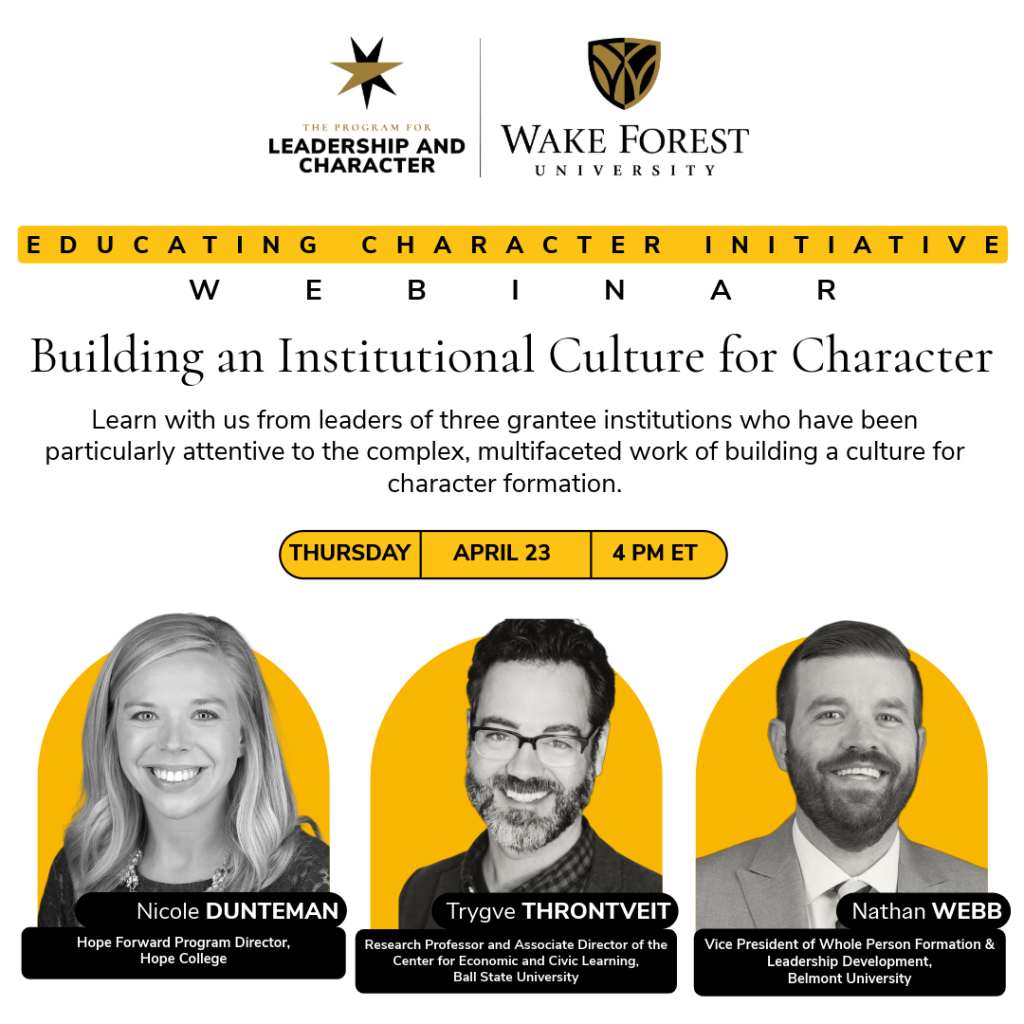
Session Leaders: Nicole Dunteman, Hope Forward Program Director, Hope College; Trygve Throntveit, Ball State University; and Nathan Webb, Vice President of Whole Person Formation & Leadership Development, Belmont University.
Description: Building an institutional culture to support character formation efforts is a complex task, requiring significant investment and commitment from institutional leaders, including presidents, provosts, deans, and department chairs, as well as deep engagement across faculty and staff at all levels of implementation. It also requires attention to an organization’s structural dimensions that can scaffold and sustain programming. In this webinar, we engage with leaders from three grantee institutions who have been particularly attentive to the complex, multifaceted work of building a culture for character formation, and we learn from their efforts to create a culture that forms character as a core dimension of the institution’s mission.
Date/Time: April 23, 4-5 p.m. ET
Moderator: Aaron D. Cobb, Senior Scholar of Character, Educating Character Initiative
Session 5: What’s on the Horizon for the ECI?
Session Leaders: Jennifer Rothschild, ECI Executive Director; Emily Hunt-Hinojosa, ECI Senior Research Scholar & Associate Director of Partnerships, and Aaron Cobb, ECI Senior Scholar of Character.
Description: Join ECI leadership for a conversation about what we’re learning from the good work occurring in the ECI Community and to hear about new opportunities on the horizon, outlined in the ECI Project Brief
Date/Time: May 21, 4-5 p.m. ET
The Flourishing Student Webinar Series, in Partnership with the Jubilee Centre for Character and Virtues at The University of Birmingham
In recent years, many universities have expressed their commitment to a holistic, socially-engaged vision of higher education and are increasingly talking about supporting students in developing ‘character’ and ‘attributes’. These are the qualities students need to navigate the fourth industrial revolution, flourish, and make a positive contribution to society.
This international webinar series, presented in partnership with the Jubilee Centre for Character and Virtues at The University of Birmingham, features presentations on universities’ role in helping their students cultivate the character and attributes required for human flourishing. Following the success of the first and second series, this third series will feature six additional world-leading universities renowned for their focus on character education, sharing their knowledge and expertise.
Session 4: SDU University, Kazakhstan
Session Leader: Speakers to be confirmed.
Date/Time: March 3, 2026, 9 – 10 a.m. ET
Session 5: University of Teacher Education Vienna
Session Leader: Roland Bernhard, professor of School Development, Leadership & Leadership Culture, University of Teacher Education Vienna/Krems, and Fellow at the University of Salzburg
Date/Time: May 5, 2026, 9 – 10 a.m. ET
Session 6: Superior University, Pakistan
Session Leader: Syed Ali Mohsin Naqvi, Director CAKCCIS, Chaudhry Abdul Khaliq Center for Contemporary Islamic Sciences
Date/Time: June 2, 2026, 9 – 10 a.m. ET
ECI Community Book Club
Our book club engages authors in conversations about their published books and their implications for character-building efforts. An ECI Scholar of Character interviews the author during the first half of each gathering, and the second half is devoted to audience Q&A.
Against Aristotelian Character Education: Practical Wisdom, Flourishing, and Liberal Democracy by Benjamin Miller

Book Description: This book argues that Aristotelian character education cannot work in liberal democracies today. It shows that when we clearly understand the basic structure of Aristotle’s value theory and correctly grasp the core requirements of liberalism, we will see that they are incompatible with one another through and through.
Neo-Aristotelian theories of character have been immensely influential, receiving endorsements from academics, educators, and elected representatives while establishing and influencing major academic centers and numerous K-12 schools, especially in the UK and US. This book argues that despite its meteoric rise and its widespread public influence, neo-Aristotelian character education should be rejected. The author argues that the underlying structure of the theory is incompatible with the sort of value pluralism and antipaternalism that liberal democracies require. The main features that make Aristotelianism attractive—its robust theory of human flourishing that grounds character and its account of the virtue of practical wisdom—are the very same features that make its educational theory illiberal. Understanding the problematic structure of neo-Aristotelian education helps us to better grasp the demands of liberal democracy while also bringing attention to the neglected question of how education for democratic citizenship can be made to fit with equal respect and tolerance of all liberal-compatible ways of living and worldviews.
The first chapter of the book will be provided to event participants.
Author Bio: Benjamin Miller is Assistant Professor in the Department of Political Science at the University of Illinois at Urbana-Champaign. His research focuses on democratic citizenship and the role citizens should play in preserving and improving democratic functioning. In democratic theory and philosophy, he is most interested in identifying which skills and value commitments citizens need to excel in their obligations as citizens.
Much of his research concentrates on understanding citizenship by analyzing the history of political thought. He is primarily focused on understanding Aristotle’s conception of good citizenship. “Many research centers, scholars policy-makers, and schools today (especially in the UK) are attracted to Aristotle’s theory of character education and brand themselves as neo-Aristotelians or proudly claim to be influenced by Aristotle. My own view is that Aristotle’s theory of virtue is fundamentally illiberal in its basic foundations and cannot be made to fit with liberal democracy’s major principle of respecting pluralism,” Miller writes. He makes this argument in his book Against Aristotelian Character Education: Practical Wisdom, Flourishing, and Liberal Democracy.
Date, Time, Location: Monday, April 13, 2026, 4-5 p.m. ET via Zoom