
Four Insights to Help you Find—and Foster—your Purpose
In an excerpt of his commencement address, senior executive director Michael Lamb talks about the ways to hone “the great moral lighthouse of the virtues.”
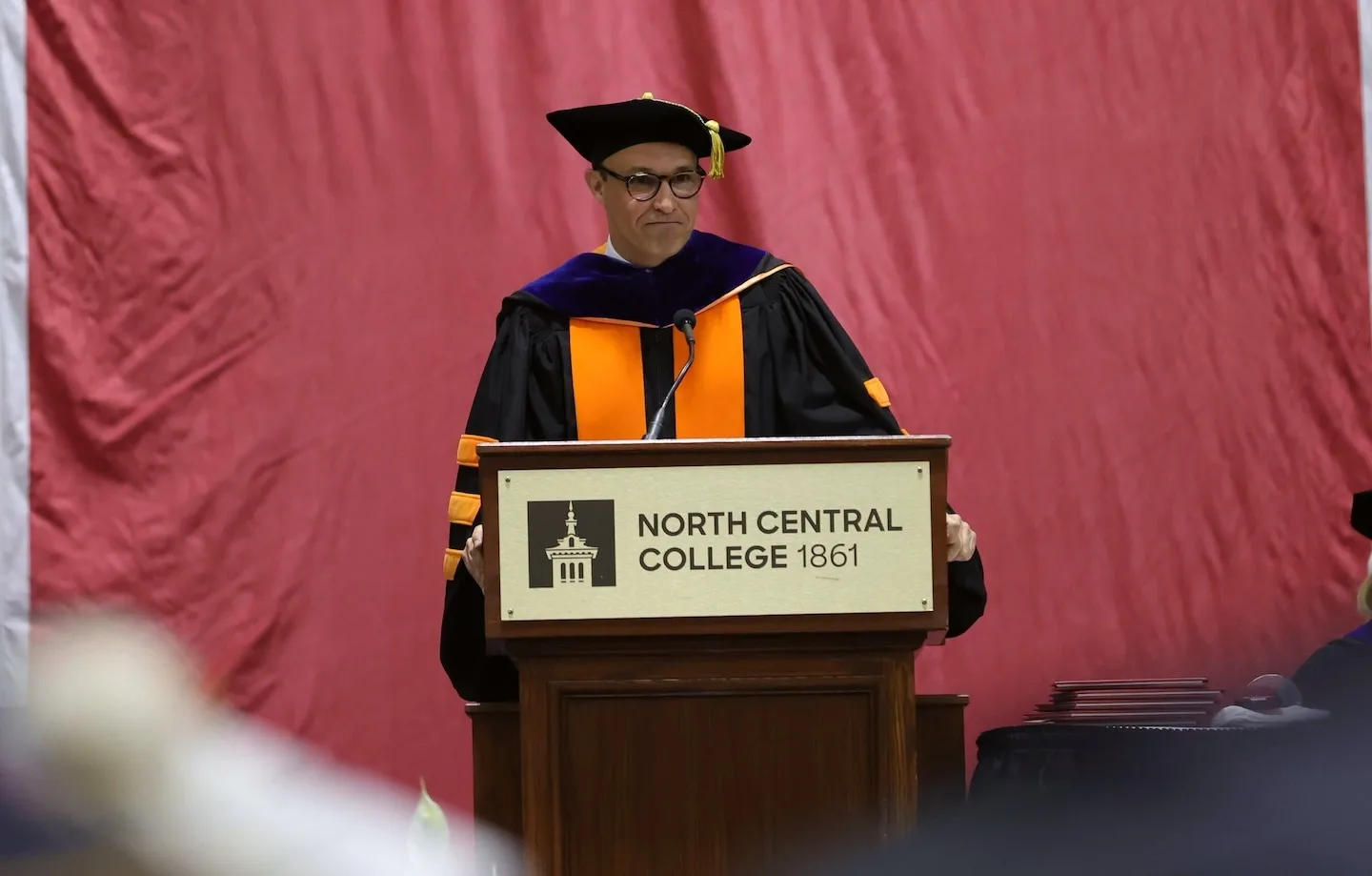

NOTE: This essay is part of an occasional series of Leadership and Character Ideas, where Program faculty, staff, and affiliates present essays on how leadership and character can be taught and applied to our modern lives. This is an adapted excerpt of a commencement address to graduating students at North Central College, delivered on May 3, 2026 by the Program’s Senior Executive Director, Michael Lamb, You can watch the entire address here.
I’ve spent much of my academic career studying character and the work of St. Augustine. In the last few weeks, I’ve learned more about the character of your St. Augustine – Augustine A. Smith, North Central College’s first president. A committed abolitionist and supporter of women’s rights, A. A. Smith founded the College in 1861 with a moral vision of education for both women and men. “A college,” he said, “should be a great moral lighthouse, sending out a clear and steady light upon all subjects.”
What a beautiful call to be a “great moral lighthouse,” a beacon that guides us, a lamp that illumines our way in the darkness, a light that helps us avoid rocky shores and find safe harbor in a storm.
That is a purpose fitting not only for a college but also for a college graduate. How can each of us be a “great moral lighthouse” for one another and for the world? How can we let our lights shine?
As North Central’s mission statement puts it, one way to shine our light is by being “curious, engaged, ethical, and purposeful citizens and leaders.”
I am especially struck by that word, “purposeful.” We need many virtues to flourish, but purpose may be the most important. Purpose is the great moral lighthouse of the virtues.
Purpose provides direction and guidance to all our endeavors, illuminating the paths we should take and those we shouldn’t.
Purpose gives us meaning and fulfillment, helping us see ordinary activities not as scattered happenings but as unified and intentional efforts in pursuit of a goal.
And purpose supplies energy and inspiration, motivating us even when the world seems difficult and dark. Those with a sense of purpose are more resilient, research shows. They don’t let obstacles deter them. As Nietzsche said, “If we possess our why of life we can put up with almost any how.”
You might find yourself asking a question that students and graduates of every age have asked: what is my purpose, and how do I pursue it?
While I cannot claim to have any final answers, through my life and work I’ve received some flashes of insight. Even if they are not as steady and constant as the beacon of a lighthouse, I want to share four insights that might provide some measure of illumination.
1. Pursuing our purpose is rarely a linear process.
Some of us here may have the next five decades planned out. Get the right job, buy the right house, find the right partner, have the right kids, and then retire at the right moment, just as the stock market hits an all-time high. Simple as that. For those with such plans, I hope your dreams come true.
But, for many of us, pursuing our purpose is far less straightforward. The zigzagging path often takes many twists and turns. It certainly has for me.
When I was sitting in your seats at my own graduation, I had a clear sense of purpose: to serve the public through politics—by running for office and working in government. That had been my dream for years, and people in my hometown nurtured it.
In college, I majored in political science, read biographies of famous political leaders, interned for a U.S congressman and state senator, and volunteered in the community to understand and address issues of poverty, hunger, and homelessness. When a professor of politics asked what I would regret not doing in life – which, by the way, is a great question to ask when discerning our purpose – my first thought was politics.
I continued on that path for some time, eventually pursuing a Ph.D. in politics, with the hope of both teaching and practicing it. In the middle of grad school, I had my chance. A mentor in Tennessee asked me to be chief of staff for his campaigns for Governor and then U.S. Congress. I took a leave to join him, knowing I’d gain valuable political experience while working for a candidate and a cause I believed in.
For many months, we worked 80-90-hour weeks, made 130,000 calls, knocked on 60,000 doors, earned 9 of 9 newspaper endorsements, and raised millions of dollars. Still we were outspent 5 to 1 in a hyper-partisan election year. We lost by a wide margin.
But even before election day, I’d realized that politics wasn’t what I thought it would be. I believed (and still believe) that we need good people called to politics – my mentor was one of them – but it was not my calling. So, I needed to redirect, to recalibrate my sense of purpose. If I had not been willing to try politics and follow those twists and turns, I might have spent decades pursuing a path that felt forced or false for me.
2. Purpose is not simply found but fostered.
When many people talk about purpose, it can sound like the crucial clue in a scavenger hunt that someone else has left for us to find. And that may be the case for some. But, as the scholar Angela Duckworth points out, a sense of passion and purpose is also something that we can foster by actively developing and deepening our interests. As we invest time, energy, and effort in a pursuit, we can discover our purpose and the meaning that comes from it.
That’s what happened for me. After we lost the election, I returned to graduate school heartbroken and confused, unsure of my purpose. But I didn’t have time to wallow. I had too many books to read and papers to write. (Graduates, can you sympathize?)
One day, as I sat in the library reading one of those books, I came across a line from Socrates.
Ever the gadfly, he was challenging a politician named Antiphon, who was not having it and turns it back on Socrates: Why don’t you walk the talk, Socrates? Why don’t you run for office, buddy?
Socrates replies: “‘How now, Antiphon?’ . . . ‘should I play a more important part in politics by engaging in them alone or by taking pains to [teach] as many competent politicians as possible?’”
In that reply, I sensed a purpose that would be fostered over the years ahead. Perhaps my calling, both personally and politically, was to serve the public not by running for office but by teaching as many competent leaders and purposeful citizens as possible.
Since then, years of studying, teaching, and writing about leadership and character have confirmed and deepened that calling. My purpose now, as I see it, is to seek wisdom from the world and share with others who are also seeking it. But that is a purpose that I’ve only fostered through experimentation and a long labor of love, in response to others’ needs, my own failures, and the longings of my heart.
3. We must let our lives speak.
In his book Let Your Life Speak, Parker Palmer shares that when he attempted to clarify his own sense of purpose, he assembled the highest ideals possible—those embodied by Martin Luther King, Jr., Rosa Parks, Dorothy Day, and other heroes. Then he sought to conform his life to those ideals. But in the process, he neglected what was true for him: his own passions and talents, his own longings and limitations, and the concrete needs of his own community.
Part of me – perhaps my ego or the expectations I’d internalized from others – didn’t want to accept that politics was not my calling. I’d ordered so much of my life around its possibility. So I had to muster the courage, humility, and patience to hear other callings. And when I listened to my life, I heard something I’d always known but never fully claimed: that I felt called to learn, teach, and write.
I wrote my first book in first grade. In fifth grade, my favorite Christmas gift was a laminated newspaper template where I could write stories in dry-erase marker to teach others about American history or my favorite athlete, Bo Jackson. In college, I wrote stories to make sense of my community service and share its impact with others. Now I write books, articles, and poems as part of my vocation and my avocation. My life had something to teach me, once I learned to listen.
I tell my students that our purpose cannot be reduced to a job or a career, even though our work-obsessed culture encourages that reduction. No, a job or career can express our purpose, but purpose is much broader than that.
I think of purpose as the intersection of three overlapping circles. The first reflects our passions, those interests that light us up and give us energy and life. The second reflects our gifts and talents, the ways that we channel our passions into practical power. And the third circle reflects the world’s needs that our passions and gifts can meet.
We need all three. If we lack passion, we can become exhausted—our light will burn out. If we do not use our gifts, we can be ineffective, unable to translate our energy into power. And if we ignore the world’s needs, we can become self-indulgent, shining light on our own feet but leaving others in the dark.
Take a moment now to reflect on your own life. What passion or interest has made you feel most alive? What are you good and gifted at? And which of the world’s many needs do you feel called to meet?
Listen to your life.
4. Purpose is not just one thing—and it’s not always glamorous.
As we consider how to pursue our purpose and represent North Central as a “great moral lighthouse,” we can also find some guidance from the most famous lighthouse in English literature—the one in Virginia Woolf’s novel, To the Lighthouse.
In that book, a young boy named James stands on the shore and looks out upon a distant lighthouse. He dreams of sailing there with his father. When they finally make the voyage – ten years later – James realizes that his romantic vision of the “silvery, misty-looking tower” obscured a more complex and gritty reality. As Woolf writes:
Now––James looked at the Lighthouse. He could see the white-washed rocks; the tower, stark and straight; he could see that it was barred with black and white; he could see windows in it; he could even see washing spread on the rocks to dry. So that was the Lighthouse, was it?
No, the other was also the Lighthouse. For nothing was simply one thing. The other Lighthouse was true too.
The same applies to our purpose: It’s not simply one thing. While its glowing ideal can animate and inspire us to set sail, we must also see it up close, in gritty detail, with laundry spread on the rocks. Pursuing our purpose requires both kinds of vision: ideal reconciled with reality, hope tempered by humility, wonder guided by wisdom.
Fortunately, graduates, North Central has prepared you with the liberal arts education you need to have such vision—to think critically, to lead with curiosity, compassion, and courage, and to pursue your purpose in all its complexity.
And it has taught you that you are not alone in this pursuit. Today, you are surrounded by many other lighthouses who have lit your path. Take a second to look around – to the left and to the right – to see all the luminaries who surround you and now stand ready to join their lights with yours. As I’ve learned in life, the best way to shine our lights is not alone but together. By seeking a common purpose, we can make our world much, much brighter.
Graduates, congratulations on your wonderful achievement. May you always, like this College, be a great moral lighthouse. We cannot wait to see you shine.
North Central College received a 2025 Capacity-Building Grant from the Program’s Educating Character Initiative. You can read more about other ECI grantees here.