
The results of large-scale surveys of college and university faculty suggest that a majority of the American professoriate considers it an important part of their role to help develop students’ character. But what do the students themselves think about this idea? Naturally, whether students support or oppose faculty members’ efforts to cultivate their character has major implications for the ethics of character education.
We recently ran a study that investigated what students think about intentional efforts on the part of faculty or institutions to foster their character growth. We also examined whether students independently aspire to good character and whether they typically perceive themselves to be growing in the ways that they would like.
This study involved 201 undergraduate students attending higher education institutions in the United States, all of whom were aged 18-24 (see below for further methodological details). We asked the students the following question:
Some colleges and universities try to intentionally develop students’ character. For example, they might try to help students become more courageous, humble, or compassionate. They might try to do this through coursework, extracurricular programs, student life events, etc. Do you support or oppose these sorts of efforts?
On a scale ranging from “strongly opposed” to “strongly supportive,” most (87%) respondents reported being at least “slightly supportive.” The most frequent response was “supportive” (43%), followed by “strongly supportive” (23%). Only 1.5% of respondents selected “opposed,” 2.0% selected “slightly opposed,” and none selected “strongly opposed.” The responses are illustrated in the figure below.
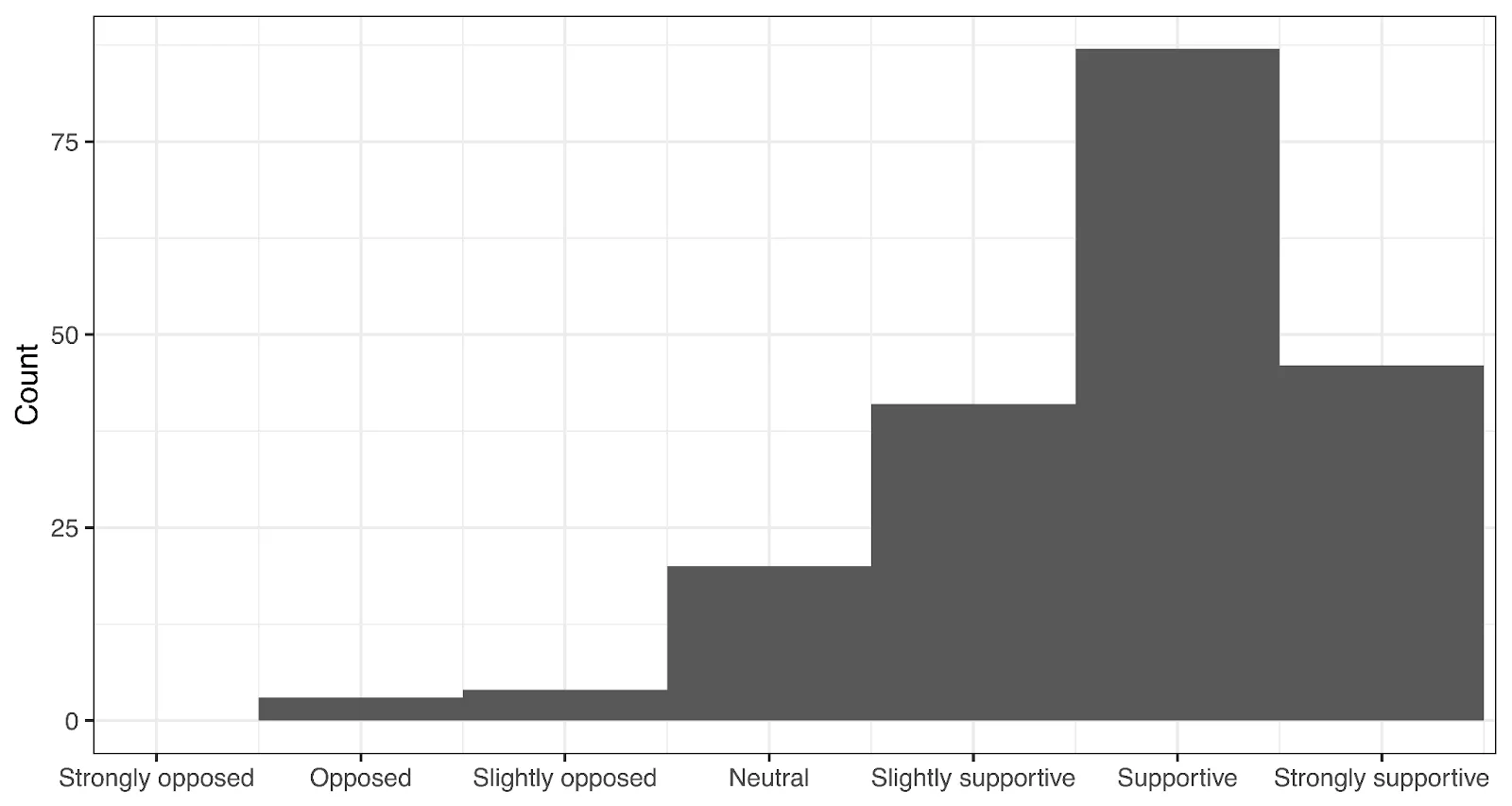
We tested whether support for character education might differ among different groups of students but found no evidence of differences across gender, race, religion, or academic major groups.
The survey also included several open-ended questions, presented prior to the question about support for character education to avoid potential bias in the responses. One was about their aims and hopes for the future. Unsurprisingly, plenty of students wrote about career or financial success, starting a family, and so on. But, in addition, we found that about one in four students spontaneously mentioned having good character or aspiring to specific virtues. When we asked them about the kinds of traits that they admired and considered indicative of good character, most of the traits that students mentioned were paradigmatic moral virtues like kindness, honesty, and helpfulness, though intellectual virtues (e.g., open-mindedness and curiosity) were also mentioned.
There was a major disconnect, however, between the traits to which students aspired and the traits that they thought they had acquired during college. We asked another open-ended question about the kinds of changes that students felt they had experienced during their time in higher education. Very few students reported growth in any explicitly moral traits. The most common traits for which students reported growth were independence, sociability, responsibility, and confidence. None of the traits that students most frequently admired (kindness, honesty, helpfulness) were mentioned even once.
Simply put, the results of this study suggest that students aspire to good character—in particular, they aspire to moral and intellectual virtue—and they support educators’ efforts to foster their character. Yet, students rarely perceive themselves to be growing in these ways. This suggests that there is both widespread support for character education among undergraduate students and widespread need. Such character programs may be able to help bridge this gap between students’ aspirations and their actual experiences.
Further methodological details
We recruited participants through Connect, an online research platform. In this sample, 53% of participants identified as women, 47% as men; 51% as White, 17% Hispanic/Latine, 14% Black, 14% Asian, 1.5% “other,” 1.5% declined to state a race or ethnicity). In our sample, 13% of participants were freshman/first-years, 23% sophomores/second-years, 23% juniors/third-years, and 40% seniors/fourth-years. In terms of religious affiliation, 32% identified as Christian, 21% as members of another religion, and 47% as non-religious. Participants reported their academic majors by selecting from a list of 31 options.
Dr. Michael Prinzing is the Research and Assessment Scholar with the Educating Character Initiative at Wake Forest University.
Dr. Juliette Ratchford is a Senior Research Fellow with the Educating Character Initiative at Wake Forest University.
Back to ECI News and Stories