
New character textbook makes virtue accessible for undergraduates
When Robert J. Hartman began teaching his first-year seminar, “Becoming a Better Person,” in Fall 2023, he set out to help students reflect on who they are, who they hope to become, and how to take steps in that direction. As he built his syllabus, though, he noticed a gap: there simply weren’t enough succinct, engaging resources on character designed for students just starting out.
Hartman — an associate professor of philosophy, effective fall 2026, at Ohio Northern University — found himself piecing together readings from journals and book chapters alongside Christian Miller’s The Character Gap, searching for something that would resonate with his students. While there are many excellent resources on moral virtue, Hartman says most are either too advanced or not quite substantial enough. So he decided to create an accessible, engaging, and thorough textbook that would meet students where they are.

His new book, Improving Character: Moral Virtues, Strategies, and Questions, comprises 45 new essays by character scholars (read the Table of Contents) and is available for preorder from Wiley, with publication in June 2026.
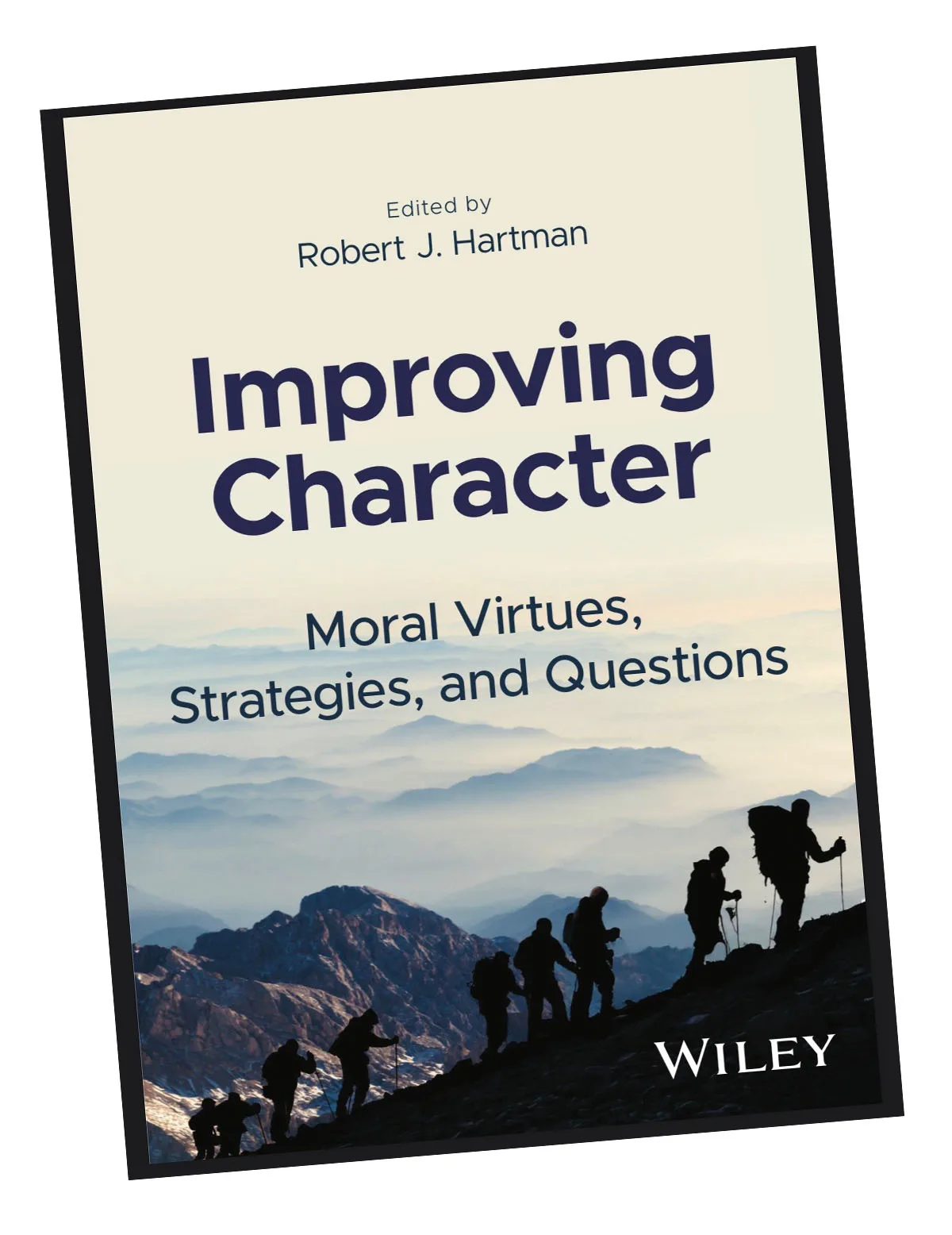
“There wasn’t any book that did everything I was doing in my class, which was trying to motivate character development, paint portraits of particular moral virtues and their vices, explore character development strategies that students could go out into the wild and try for themselves, and then ask a bunch of questions about the whole enterprise to promote their critical thinking,” said Hartman.
Hartman knew the textbook needed to guide students through character development in a way that felt approachable and relevant to a modern audience of 18-year-olds. To do this, he invited 45 scholars to contribute concise, mostly jargon-free essays—each under 3,000 words—written with first-year students in mind.
“Students often are baffled when they read the great philosophers, and they come to class thinking, ‘I didn’t understand any of this.’ And then the ‘sage on the stage’ (the professor) makes it all clear,” says Hartman. “I think there is a place for that. And I think that it’s good for students to struggle through those old texts. But how much better would class be — at least for students on the introductory side — if they could understand it very well from the get-go, and then come in with their own thoughts and have a really robust discussion about it?”
The aim of making the language more accessible is to build momentum so they really start to care about these topics. If we can remove some of the pain of trying to understand philosophy, I think more people will get hooked.
To ensure the book would be both consistent and not too difficult to track, Hartman asked each contributor to write from an Aristotelian perspective on virtue. This common framework helps students follow along, while still allowing each author to bring their own insights and experiences—whether from religious, philosophical, or other traditions—into their essays.
Hartman’s vision for this project was supported by a 2025 Educating Character Initiative (ECI) Teacher-Scholar Grant, which allowed him to dedicate time to reading and requesting revisions to each essay.
While the textbook is designed for undergraduates encountering character and virtue for the first time, its reach is broad. Hartman envisions it being used in philosophy courses, by athletic teams exploring the virtues relevant to their pursuits, and by honors college students reflecting on their own growth. It’s also a valuable resource for anyone — inside or outside the university — who is committed to cultivating good character.
“I think philosophy is really valuable. And I think many students value it without realizing it. But if the process of their learning philosophy is too painful, they’re just going to turn away and leave that value behind,” Hartman reflected. “But if we can take some of the pain out of learning it by providing concise, engaging essays that use real-life examples and are mostly jargon-free, then they can find the value in philosophy without having to work so hard to get it. The aim of making the language more accessible is to build momentum so they really start to care about these topics. If we can remove some of the pain of trying to understand philosophy, I think more people will get hooked.”
Improving Character: Moral Virtues, Strategies, and Questions is now available for pre-order at:
Join the ECI on April 7 from 3 to 5 p.m. to hear from this year’s Teacher-Scholar Grantees as they share about their projects.