
Some researchers have argued that the concepts of virtue and character have become less prominent in ordinary thinking in the United States—in other words, as one study concluded, the “cultural salience of moral character and virtue declined in twentieth century America.” This conclusion aligns with a popular, if perhaps overstated, narrative of moral decline. According to this narrative, people are becoming less virtuous and the cultivation of good character has taken a backseat to more mercenary pursuits, such as professional and financial success.
One source of evidence for these kinds of claims comes from trends in how people use language. For example, the study cited above used data from Google Ngrams, which tracks how often specific words appear across millions of digitized books. The researchers examined how frequently 50 virtue terms (like “honesty,” “kindness,” “humility,” “courage,” and so on) were used in texts published between 1901 and 2000. The trends looked different from one term to the next. But most of them came to be used less often.
The larger story is one of a long decline that occurred long before any of us were born, followed by recovery that is currently underway.
But is this the full story? I reanalyzed the same data used in that study, but I looked further back in time and also included more recent data that were not available in 2012, when the study was originally published. Specifically, I examined how frequently these same 50 virtue-related terms were used between 1800 and 2022. The results were striking, and led to a completely different conclusion.
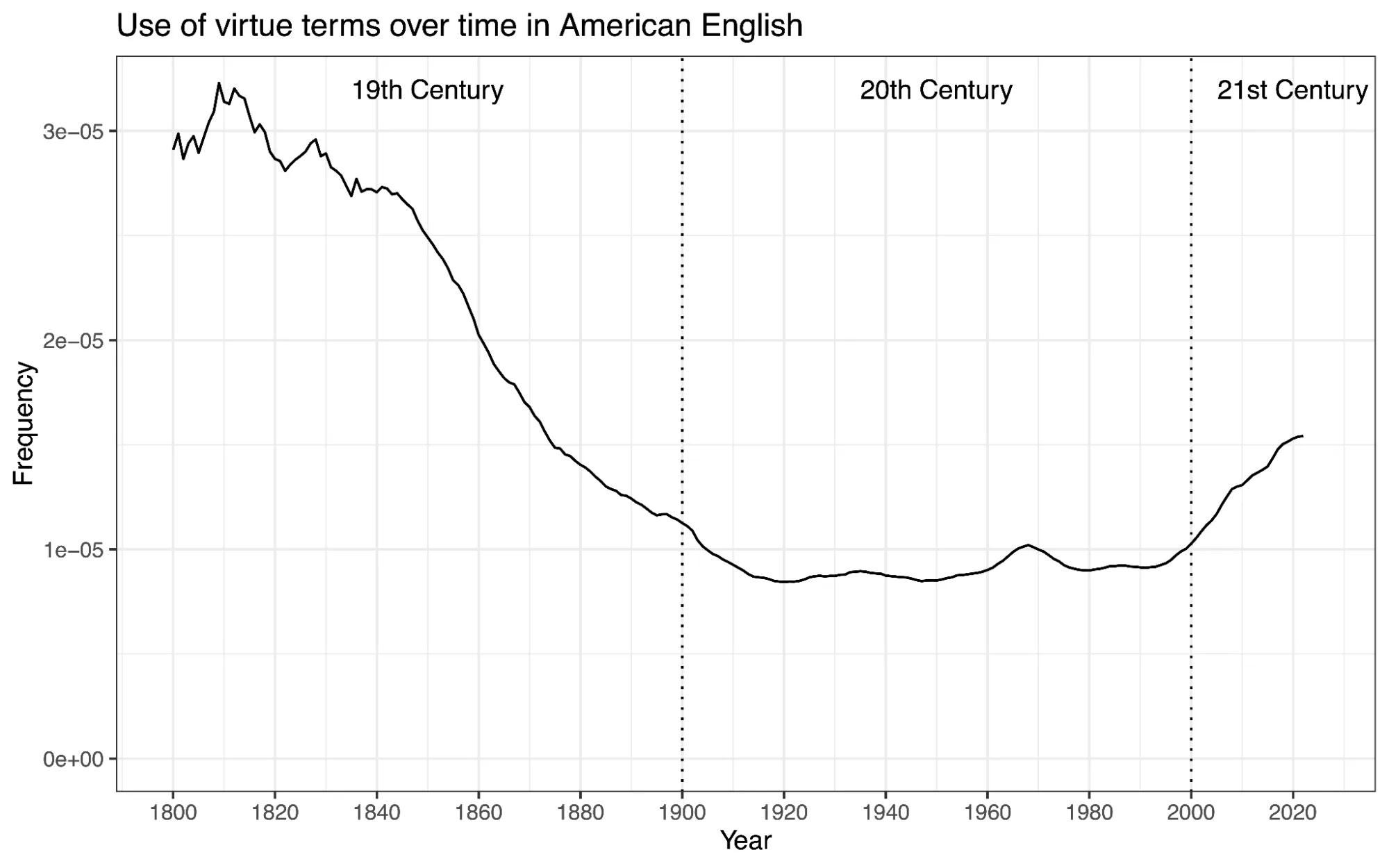
The first two decades of the twentieth century were at the tail end of a much larger, longer decline that began during the nineteenth century. Use of these virtue terms fell sharply from a highpoint in the early 1800s. Then, they leveled off around 1920 and held relatively steady until the 1990s. Since the 1990s, however, the decline has completely reversed. Indeed, the rate of growth during the first two decades of the twenty-first century is just as strong as the rate of decline during the nineteenth century. This suggests that, contrary to the original findings, the cultural salience of virtue and character is not declining. It is greater now than at any point since around the time of the Civil War.
For educators interested in developing students’ character, it can sometimes feel like swimming against the current of a culture that views these sorts of concepts as antiquated and irrelevant. But these data suggest that an educational focus on character is in line with, and part of, a broad cultural shift.
Of course, none of this means people today are more honest, courageous, or wise than they were at other points in history. The frequency with which people use words like “honesty,” “courage,” and “wisdom” can’t tell us much about whether they possess these traits. Nor can it tell us precisely what people mean when they use the terms. For example, people today may have different ideas about what it means to be courageous, compared with people a century ago. But the idea that the vocabulary of character is being slowly drained from American culture doesn’t hold up. The larger story is one of a long decline that occurred long before any of us were born, followed by recovery that is currently underway. Thus, although these data don’t speak to the question of whether virtue and character are on the rise, they do indicate that the cultural salience of the concepts is on the rise.
For educators interested in developing students’ character, it can sometimes feel like swimming against the current of a culture that views these sorts of concepts as antiquated and irrelevant. But these data suggest that an educational focus on character is in line with, and part of, a broad cultural shift. As the character education movement has grown in recent decades, it has paralleled this conceptual shift taking place within American society more broadly.
Methodological details
I accessed the Google Ngrams data using the ngramr package in R, retrieving frequencies from the US English corpus from 1800 through 2022 (the most recent year available at the time of writing). In the figure above, the trend line shows the mean of the 50 virtue terms used in Kesebir & Kesebir (2012), the study cited above: honesty, patience, honor, truthfulness, kindness, sincerity, courage, generosity, mercy, wisdom, humility, faithfulness, charity, humbleness, bravery, thoughtfulness, grace, helpfulness, courtesy, love, perseverance, modesty, politeness, fidelity, justice, gratitude, diligence, thankfulness, gentleness, sacrifice, benevolence, fortitude, purity, temperance, faith, hospitality, appreciation, compassion, integrity, fairness, tolerance, selflessness, discipline, dependability, reliability, loyalty, trustworthiness, forgiveness, respect, and determination.
In Kesebir & Kesebir’s analyses, they examined Pearson’s correlation coefficients between each virtue term and year. However, this approach yields a large number of coefficients and is not well-suited to generalizing beyond the set of virtue terms that were included in the analysis. Hence, I examined the historical trends using mixed-effects models. I fit separate models to the data from the 19th, 20th, and 21st centuries. In each case, I regressed frequency on year (rescaled so that the baseline year is 0) and allowed random intercepts and slopes for the different virtue terms. Contrary to Kesebir & Kesebir’s findings, I actually found no significant change in the frequency with which these terms were used, between 1900 and 1999 (b = 1.20e-09 , 95% CI: [-3.43e-08, 3.67e-08], p = .947). However, there was a significant decline between 1800 and 1899 (b = -2.32e-07, 95% CI: [-3.49e-07 -1.14e-07], p < .001) and an equivalent increase between 2000 and 2022 (b = 2.39e-07, 95% CI: [2.87e-08, 4.50e-07], p = .026).
Dr. Michael Prinzing is a Research and Assessment Scholar for the Educating Character Initiative