
Inspired Medical Student blends Creativity and Community to produce a Guidebook for her Classmates
When Geetika Verma arrived at the Wake Forest School of Medicine, she needed help to navigate her new surroundings. Afterward, she used what she learned to create a guidebook to help others.
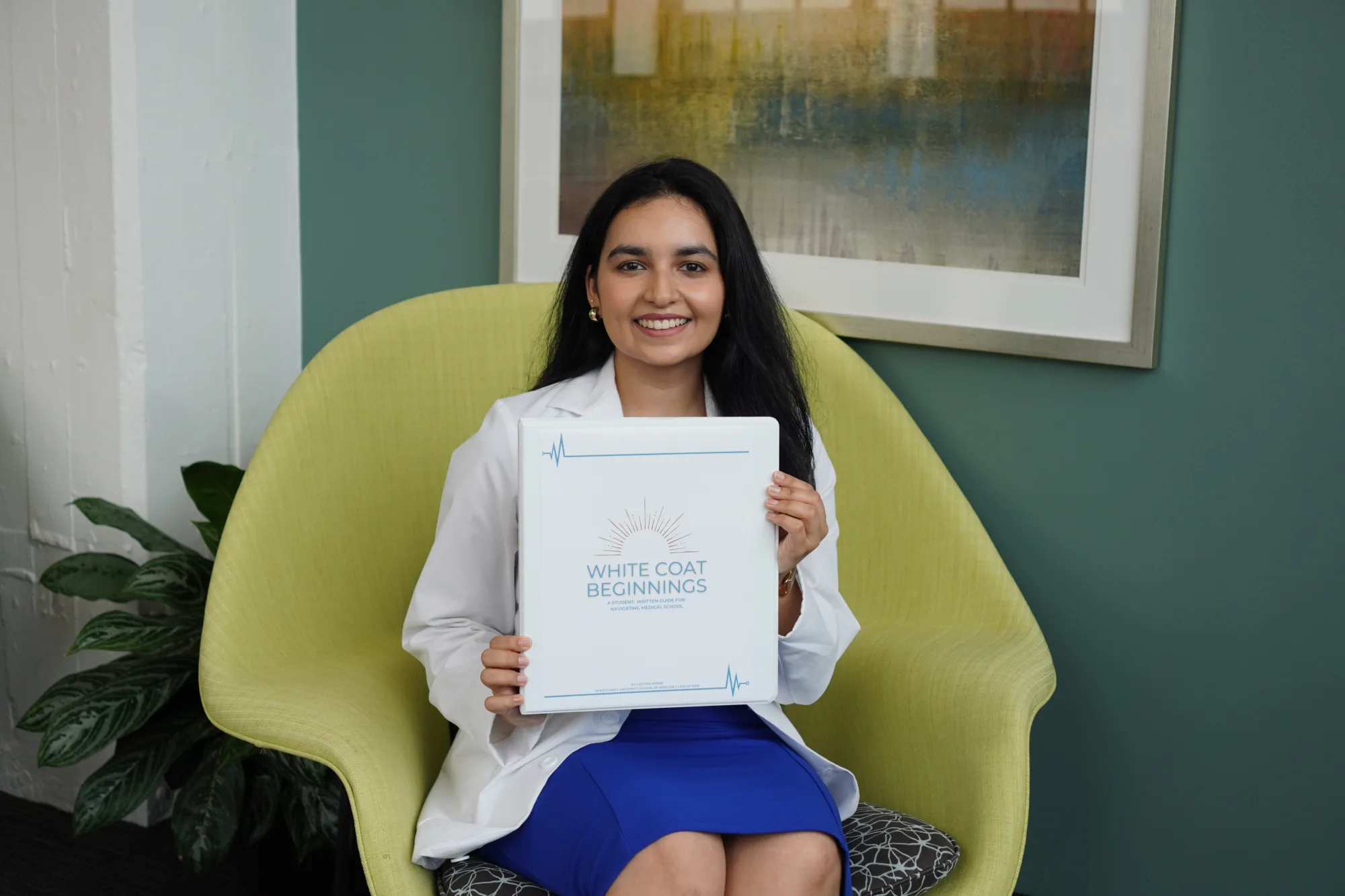
Geetika Verma (’28 MD) is a second-year M.D. student and member of the Leadership and Character in Medicine and the Law Cohort. She grew up in New York as one of four sisters in an Indian-American household where her parents emphasized the importance of learning. They stressed that “education is your foundation,” but also instilled her with a strong sense of service. “When I was younger, I just thought that you’re supposed to show up for the people around you. You’re supposed to help one another. You’re supposed to want to drive change,” she says. “That’s how I saw my parents and my siblings leading their lives and I aspired to bring that legacy forward.”
That desire continued during Verma’s undergraduate years at Rensselaer Polytechnic Institute and through her first job at Johnson & Johnson. In 2024, she enrolled at the Wake Forest University School of Medicine in Winston-Salem. As a first-generation medical student, she saw an opportunity to help others who, like her, initially struggled to find what they needed. “I was looking for support, not just for the academic classroom learning, but for navigating the journey,” says Verma. “I knew Wake had a lot of resources, but it was a matter of identifying who to turn to for what.”
“I wanted to make sure that not only mine, but other people’s voices were also heard.”
Verma’s answer to that need was “White Coat Beginnings,” a guidebook she created with help from several members of the medical school’s faculty and staff, including Leadership and Character collaborators David Mullins, Marcia Wofford, and Roy Strowd. “I encouraged her, but she did all the work,” says Wofford, an associate dean. “She reached out to other faculty. She got the support of the instructional design team. But it was her idea and her energy that made it happen.”
Verma knew it would be a large project. “I like to think big,” she says.
She not only compiled resources but created sections that mirror the Seven Strategies for Character Development. One section features prompts that encourage students to reflect on their journey, their challenges, and their “why.” Another section includes advice and insight from the Wake Forest Medical community including students, faculty, and physicians. “I wanted to make sure that not only mine, but other people’s voices were also heard,” Verma says.
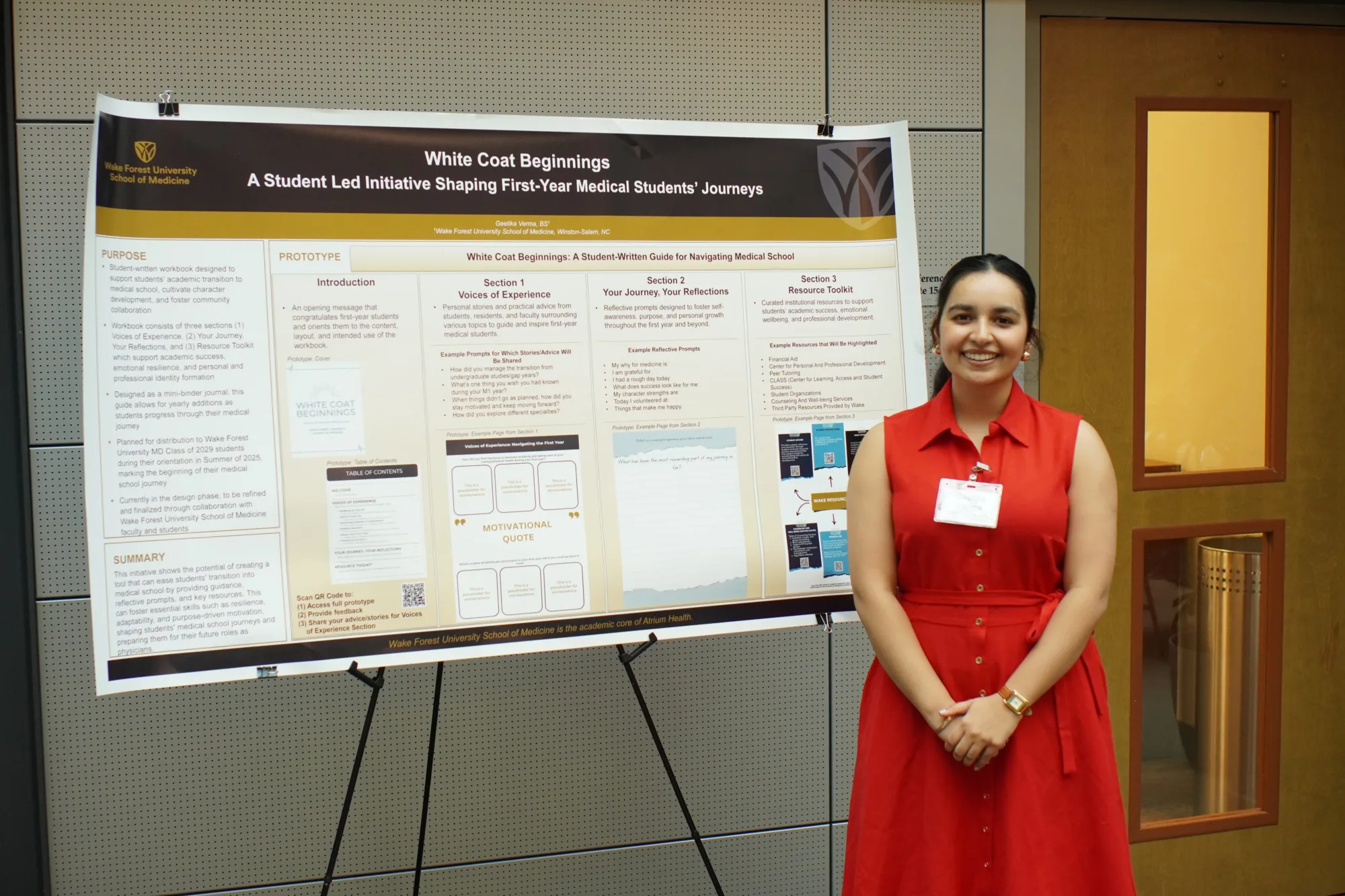
Last May, Verma presented her guidebook at the Kern National Network (KNN) Becoming Series and the 2025 Character in Medicine Conference, which was funded by the School of Medicine and the Program with support from the Kern Family Foundation (KFF). Then she began printing out 150 books for incoming students. In July, she finally distributed the books to the Class of 2029 at LAUNCH, the medical school’s orientation course. “I had so many of them come to me right after we distributed the book saying, ‘Thank you so much, this really shows how much you care for us,’” says Verma. “I was just really happy to be a part of a school that cared enough to allow me to do this and supported me in that journey.”
The legacy of White Coat Beginnings is continuing through those first-year students who first received the book. With the guidance of Verma, Hanna Sauer (MD ‘29), Khush Parekh (MD ‘29), and Vaibhav Desikan (MD ‘29) have produced the second edition of White Coat Beginnings ahead of the MD Class of 2030’s orientation. These students and their peers will continue to build upon this project as it evolves to meet the current needs of students.