
In Germany, A Question of What’s Legal vs. What’s Just
Leadership and Character in the Law Scholars take a trip through Germany to discover the tension between the German laws of the past that enabled atrocities and the growth since then that enabled empathy and compassion in modern lawmaking.
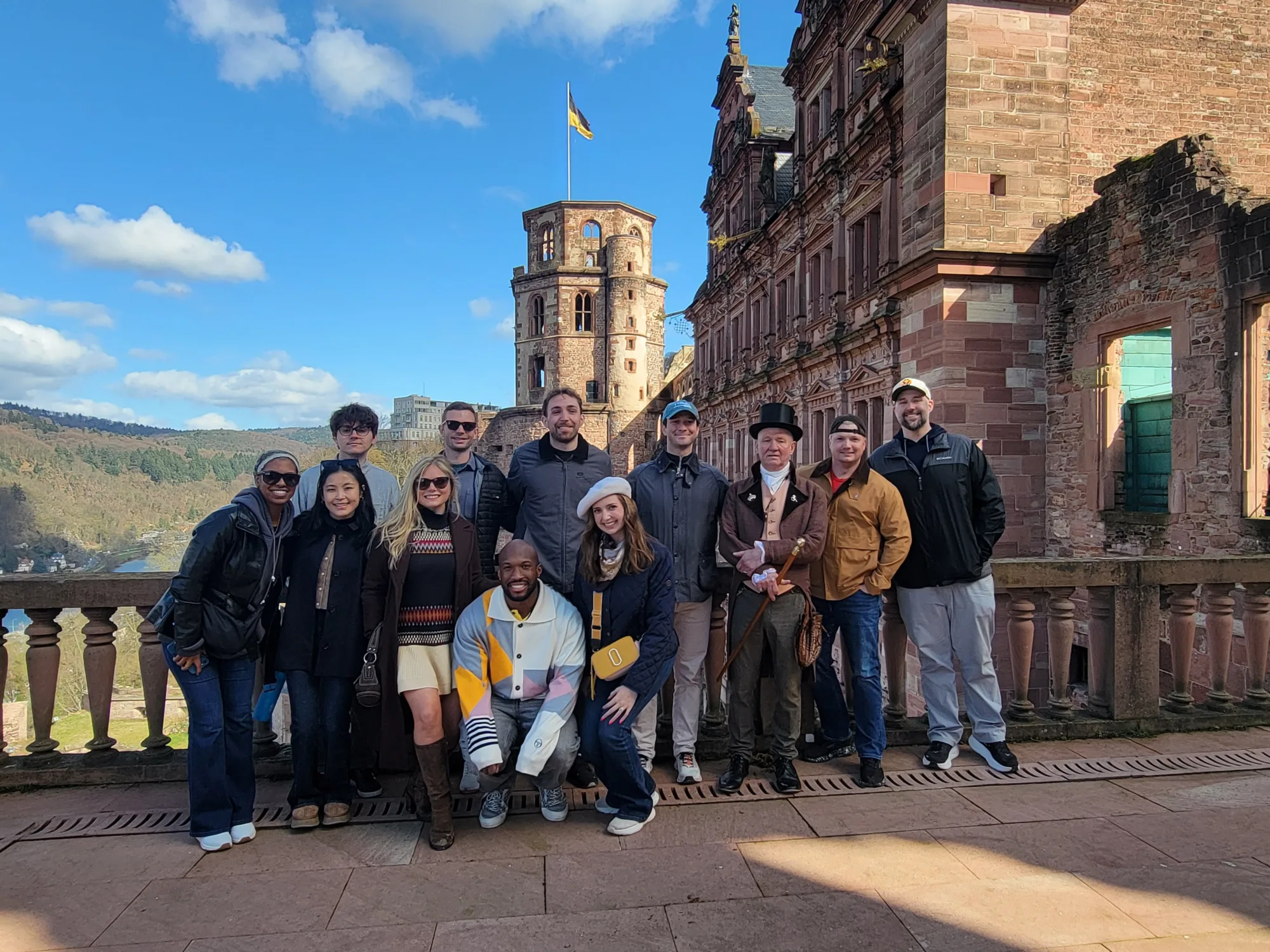
In March, 10 Leadership and Character in the Law Scholars embarked on a spring break trip to Germany led by Associate Director of Leadership and Character in the Law School Benjamin Rigney and Assistant Director of Curriculum and Pedagogy in the Professional Schools Nancy Winfrey. “The purpose of the trip was for us to look at the difference between justice and law. And what we saw repeatedly is that, frankly, law can be used to hurt people as much as it can be used to help people,” said Rigney. “So we asked: What is the purpose of law? What is justice? How does law interact with justice? And how do we, as lawyers who can pull these kinds of levers of power, use that power to help people versus punishing people?”
The students visited Munich, Rothenburg, Nuremberg, Heidelberg, and Frankfurt. They toured museums and historical landmarks that painted a picture of World War II and medieval European law enforcement. They also saw the beautiful German architecture, walked the streets of culture-rich towns, and dined in world-renowned restaurants. The trip brought a fuller, more balanced scope of Germany’s complex history, culture, and legal system.
The Program tasked four of the students with vlogging and capturing the experience as it happened: Joshua Flemings (JD ’26), Hanna Yalew (JD ’27), Ethan Rummage (JD ’28), and Anastasia Jones-Burdick (JD ’28). Here are the moments that spoke to them:
“The court in Nuremberg had continued to be used as a normal courtroom [until 2020]. Courtrooms see all manner of different things, and we don’t need to change the courtroom itself for the crime that’s been committed. We’re not going to dress up or change a courtroom because you’re a murderer or because you have a traffic ticket. The courtroom will always be the same. And that kind of goes to what I think is a poignant point that all are equal before the law, all are equal before justice. The law itself shouldn’t change and doesn’t change. And so the courtroom shouldn’t change and doesn’t change no matter who’s coming before the court. The court and the law must be immutable, and justice must be given out equally.”
-Joshua Flemings, JD ’26
(Watch his full take on the courtroom here.)
“Without a normative ethic behind it, the law is a tool that can be used either for good or for the most heinous of evil to be perpetrated on innocent people. It makes me think, as a law student, that it’s important for all of us not just to focus on the content of the law—what the law says, what the law implies that we ought to do—but what normative power or ethical system is being advanced by the law? Because law without moral contemplation has an equal ability to be helpful and harmful in the most egregious, indescribable matters by which human beings are capable.
I think what really struck me from that was the fact that when laws fall apart, and paramilitary groups and political convenience became sort of the order of the day … it’s not just dangerous for those who are actual political opponents, but it’s a danger to every single person. Without security for everyone, there really is no political security or freedom for anyone. If the rule of law doesn’t apply to every single person, it truly applies to absolutely no one, and no one is safe.”
-Ethan Rummage, ’25, JD ’28
“We visited the Crime and Punishment Museum here in Rothenburg, Germany, and the museum showed how justice and punishment worked in medieval Europe. And one of the things that stood out to me was the collection of actual torture devices and punishment tools that were used centuries ago. They also had exhibits on different types of laws that people had to follow back then, and the historical context behind those laws. And what I found really interesting was how much the idea of justice and lawyering has evolved over time, and how there weren’t really lawyers in the medieval times; [they were] more so advocates. And seeing a lot of the methods that were used up close made me appreciate the modern legal system that we have today and how it focuses on protecting rights and instituting due process for those that are accused. Overall, the museum was really eye opening and was definitely a unique stop.”
-Hanna Yalew, JD ’27
“Today we spent the morning and most of the afternoon in the Museum of National Socialism. And while the Western world may now conceptualize socialism as the left-leaning ideology, in Germany it means so much more. National Socialism was the political movement that enabled the Third Reich, and we spent the entire morning not only within the Documentation Museum, understanding exactly what happened during the Third Reich, the preface and the aftermath that continues to shape our international relations to this day, but also at The Brown House. The Brown House is essentially the home of the Nazi Party. Although this is a very somber and truly humbling physical place, I really appreciated that the museum has taken this physical place and turned it into a space of healing and learning and growth.”
-Anastasia Jones-Burdick, JD ’28
If you want to learn more about the Leadership and Character in the Law Cohort, visit our website.